 iPhoneRoot.com

News from category ‘Official’
Enterprise adopting Apple products as company becomes 'easier to work with'
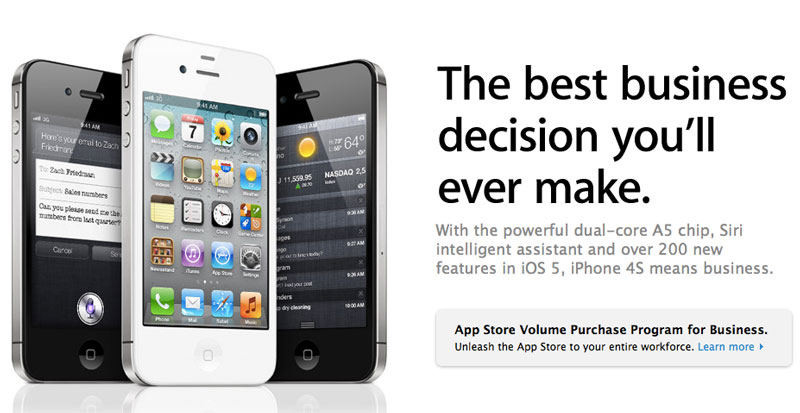
The New York Times published an article by Nick Wingfield where Apple’s growth in enterprise sector of the market was revealed, noting that the current Apple’s CEO Tim Cook is "more at ease" meeting with enterprise customers, while Jobs disliked working with businesses.
"While corporate technology buyers say Apple does not try to hide the fact that consumers are still its top priority, they note that the company has gotten easier to work with in recent years, adding features to its devices that make them more palatable to business," author Nick Wingfield wrote.
Under Jobs guidance corporate customers were often rubbed the wrong way. Tim Cook, even before being appointed Apple’s CEO, was said to engage in more communication with the company's enterprise clients.
"(Cook) met more frequently with corporate customers and seemed to appreciate their needs, even if he did not deviate from Mr. Jobs's views about making consumers the priority when making Apple products," the report said.
Apple's new success in the enterprise belongs largely to the iPhone and iPad. According to the recent reports, 93 percent of Fortune 500 companies are deploying or testing the iPhone, while 90 percent are deploying or testing the iPad. Macs also have found its place in enterprises. Moreover, as it was found out, Mac business users are more productive than their PC counterparts.
Apple, Chinese environmental groups meet to discuss supplier pollution concerns

On Tuesday Apple held a meeting with five Chinese environmental protection groups in Beijing. While a three-and-a-half hour meeting Apple and representatives from Chinese companies were discussing domestic supplier pollution and reports, criticizing the company for using loopholes in the system.
The representative of EnviroFriends, Li Li, who took part in the meeting, claimed that the company continues to put the burden of responsibility for pollution on its suppliers. But Apple refuses to reveal its suppliers, thus, the groups decided to carry out their own research to discover suppliers working with Apple. During the meeting Apple admitted that 15 out of the 27 suppliers accused of excessive pollution were suppliers for the company.
"Apple said they had already spoken to 11 supply firms and asked them to reform, and they’re in the process of initiating communications with the other four," Li said.
"Apple is committed to driving the highest standards of social responsibility throughout our supply chain. We require that our suppliers provide safe working conditions, treat workers with dignity and respect, and use environmentally responsible manufacturing processes wherever Apple products are made," said spokeswoman Carolyn Wu.
Remind you that this year Greenpeace ranked Apple as the fourth-greenest device maker, up five spots from last year.
Apple rumored to issue iOS 5.0.2 for battery woes, iOS 5.1 with Siri additions
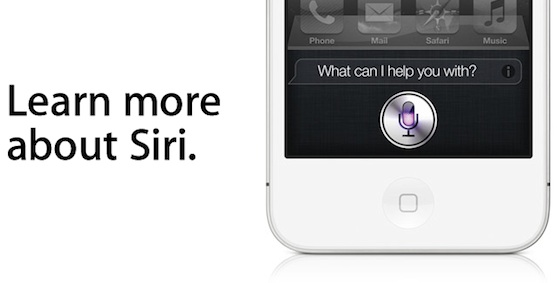
German site Macerkopf reports that Apple is working on two software updates for iOS 5 to fix battery issues and to add new features to Apple’s voice recognition assistant Siri. Macerkopf tells us:
iOS 5.0.2 coming very soon, solving the battery bugs. Should arrive before the end of next week. Apple is working hard on the update. In addition Apple is working on the first big iOS 5 Update (iOS 5.1), bringing some Siri-extensions. Also the Siri hardware-control is in work "take a picture", "make a video", "switch on/off WiFi", "switch on/off BT" and more.
The new update will be iOS 5.0.2 and is expected to be released next week to address continued battery life issues even after last week's release of iOS 5.0.1 that was also targeted at solving battery issues. But there are still no signs of developer testing for an iOS 5.0.2. The other update Apple is working on to improve Siri functionality on the iPhone 4S will be probably dubbed iOS 5.1. The update seems to be released earlier next year. Apple may add new languages and expansion of maps and local search to new countries in the update.
Samsung's Patent Cases Against Apple to Ramp Up in 2012
Bloomberg reports that Samsung has won an early trial date of March 2012 for its case against Apple in Australia. Noteworthy, the judge accepted that proposal over Apple's opposition that requested a trial date of August 2012.
Australia Federal Court Justice Annabelle Bennett today ordered that a trial on Samsung’s claims be held in March. Cupertino, California-based Apple had opposed an early trial, with its lawyer Stephen Burley saying the company needed more time to prepare the case and favored a hearing in August.
Samsung, the world’s biggest maker of smartphones last quarter, dropped its bid for a temporary injunction barring Apple from selling the iPhones and iPad 2 and instead is seeking an early hearing. The Australian trial will be a prelude for Samsung in its U.S. case before the International Trade Commission on similar claims, which Burley said will be heard in May and June.
With the trial set for March 2012 Samsung may also add to its case against Apple new devices such as iPad 3 that is rumored to be released early 2012. The case is currently targeting the iPhone 4, iPad 2, and iPhone 3GS in Australia.
Android Tops 50% Share of Smartphone Sales, But Apple Still Dominating Profits
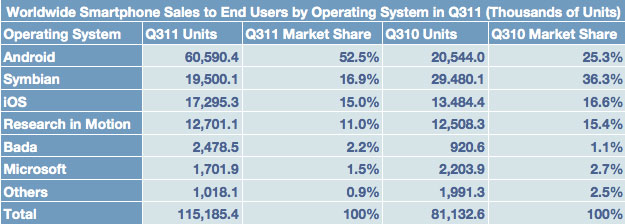
According to the results of worldwide mobile phone sales for the third quarter of 2011, released yesterday by the research firm Gartner, Apple's share of the total mobile phone market came in at 3.9% for the quarter, down from 4.6% in the previous quarter. However, Apple still takes fourth place behind Nokia, Samsung, and LG.
Apple shipped 17 million iPhones, an annual increase of 21 percent, but down nearly 3 million units from the second quarter of 2011 because of Apple's new device announcement in October. Gartner believes Apple will bounce back in the fourth quarter because of its strongest ever preorders for the iPhone 4S in the first weekend after its announcement. Markets such as Brazil, Mexico, Russia and China are becoming more important to Apple, representing 16 percent of overall sales and showing that the iPhone has a place in emerging markets, especially now that the 3GS and 4 have received price cuts.
iOS share slipped from an 18.2% in the second quarter to 15.0% in the third quarter. Android and Nokia with its soon-to-be-defunct Symbian platform are now leaders of the market. During the quarter, Android’s share increased by 52.5%, more than doubling year-over-year.
But Android dominates the worldwide smartphone market by units while Apple by profit. Some researches show that Apple now takes more than a half of the industry's profits.
Developers crack Siri’s security protocol to enable it with any device
A team of developers called Applidium has announced that they managed to investigate how Siri, exclusive service available on the iPhone 4S, talks to Apple servers. Applidium notes that iPhone 4S uses standard HTTPS network requests to communicate with Apple's servers, but sends data using an "ACE" command rather than regular web GET requests. Moreover, each Siri request involves a unique identifier based on UUID. Such identifier prevents access of unauthorized devices to Apple’s servers. User’s requests are compressed with the Speex audio codec optimized for VoIP. Applidium discovered that iPhone, to provide Siri’s voice recognition, should support at least Siri's basic voice recognition features, but Apple doesn’t plan to port such capabilities on earlier iOS 5 models.
So far, Applidium's investigation has revealed that Siri packages requests in compressed property lists, but further exploration of the protocol is hampered by a number of issues, including the complexity of requests, the fact that they are tied to a hardware key, and that they are subject to change.
Noteworthy, Apple could at any time stop supporting a particular hardware identifier, if it is suspected of being used to exploit its servers, and change way of data transmitting.
Applidium says "anyone could now write an Android app that uses the real Siri! Or use Siri on an iPad!" But you will need a real unique user key of an actual iPhone 4S.
Apple to revamp the Genius Bar with iPads, drop the Macs

Typically geniuses staying behind Genius bars use MacBook Pros to provide customers with help and support, facilitate repairs, look up customer information, and order new parts. But last week some Apple retail stores replaced MacBook Pros with iPads that can mirror functionality of the laptops.
These iPads will obviously make the Genius’ job easier and provide a much better experience for Apple’s customers that are looking for repairs and/or help from the Genius Bar. At least one reason for the iPad is that Apple’s tablet is portable so that geniuses can help customers anywhere in a store. So use of the iPads may transform Genius bar from a place in a store where you may receive quality help to the service that you can get anywhere in a store.
Using MacBook Pros, Apple has been limited to fitting only a few the computers at Genius Bars. The iPad allows Apple to serve more people at one time at Genius bar. Moreover, Apple has already developed a system called MobileGenius, which runs on iOS devices and provides the same services as MacBook Pros.
Apple Becomes Top Five PC Vendor in Western Europe
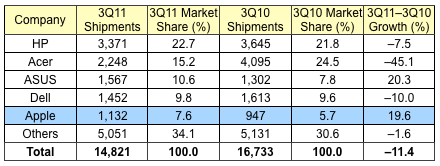
Research firm Gartner recently released its estimates of PC sales in Western Europe for the third quarter of 2011. Despite the overall decline of 11.4% for the market, Apple’s sales in Western Europe were up 19.6% year-over-year. In mobile PC market Apple showed the most significant performance of 28%, comparing to the last year performance.
Gartner especially paid attention to the United Kingdom, France, and Germany, noting that in the UK Apple became one of five top vendors. Apple’s sales here increased up to 21.8% year-over-year. So now the company takes the fourth place in the United Kingdom with 7.8% of the market. Apple’s rival Samsung goes slightly behind with 7.3% of the market, despite the fact that Samsung’s growth there was 39%.
As for the U.S. PC market, Apple took 12.9% for the third quarter, demonstration significant increase in sales both quarter-over-quarter and year-over-year.
Apple's October Mac Sales Lining Up for Record 5 Million+ Units in Quarter

According to a new research carried out by Piper Jaffray analyst Gene Munster, Apple’s October Mac sales in the United States were up 19% year-over-year. That means that the company could reach analysts’ expectations and sell 5.1-5.3 million units for the full quarter.
Analyst Gene Munster with Piper Jaffray shared the latest domestic sales data from the NPD Group on Monday, which showed Mac sales up 19 percent year over year in the month of October. As sales continue to pick up leading up to Christmas, he sees Apple selling between 5.1 million and 5.3 million Macs during the December quarter.
Those numbers would represent year over year growth of between 23 percent and 28 percent. Consensus on Wall Street has called for Apple to report sales of about 5.2 million Macs during the quarter.
Last quarter Apple managed to sell 4.89 million Macs. These very numbers spurred analysts to push their Mac estimates to over 5 million.
Unfortunately, the iPod shipments in the United States are continuing to decrease. In October the iPod sales were down about 18% year-over-year. That might be connected with the fact that more and more consumers prefer to use smartphones for portable music needs rather than music players. Nevertheless such decline is smaller when it was expected. Analysts predicted a 20% drop for this quarter. That is why Munster suggests that Apple may sell approximately 16 million music players in for the full quarter.
Adobe manager puts partial blame on Apple for mobile Flash failure
Mike Chambers, Principal Product Manager at Adobe, blames Apple of halting development of the Flash Player for mobile devices, because Apple refused to support Flash on its iOS devices. As he clarified, Adobe will support existing versions of Flash Player for mobile devices, and concentrate on HTML 5 technology.
"Considering how politically charged the issue has been, the decision to stop development of the Flash Player for Mobile Browsers was not an easy decision. However, at the end of the day, there were a number of items that made it clear that putting resources towards its continued development would not be the best use of resources," he wrote.
Apple is Now Selling Unlocked Contract-Free iPhone 4S in the U.S.
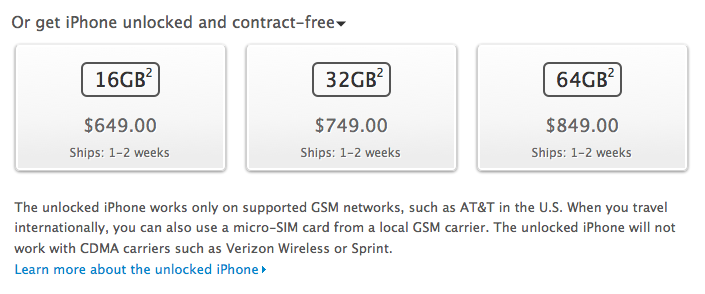
As it announced last month, Apple is now officially selling the iPhone 4S unlocked and contract free in the U.S.A.
The unlocked iPhone includes all the features of iPhone but without a contract commitment. You can activate and use it on the supported GSM wireless network of your choice, such as AT&T in the United States. The unlocked iPhone 4 or iPhone 4S will not work with CDMA-based carriers such as Verizon Wireless or Sprint.
If you don't want a multiyear service contract or if you prefer to use a local carrier when traveling abroad, the unlocked iPhone is the best choice. It arrives without a micro-SIM card, so you'll need an active micro-SIM card from any supported GSM carrier worldwide. To start using it, simply insert the micro-SIM card into the slot on your iPhone and turn it on by pressing and holding the On/Off button for a few seconds. Then follow the onscreen instructions to set up your iPhone.
You can the 16GB, 32GB, and 64GB unlocked iPhone 4S for $649, $749, and $849 respectively.
 Leave a comment, read comments [2]
Samsung seeking injunction against Apple's 3G products in Germany
Samsung has made a next step in its legal battle with Apple, having initiated new efforts to ban Apple’s 3G products in Germany. Now Samsung and Apple are arguing over what devices might be covered under the injunction Samsung seeks, which would include a prohibition of sales of iPhones and iPads with 3G features. Apple is now doing its best to protect the iPhone 4S from consequences of the injunction that might be granted. This time Samsung plans to use the same methods and patents that Motorola used recently. The German court granted Motorola Mobility an injunction against Apple covering its German sales.
Now Samsung raises questions that include whether Apple is infringing patents that were licensed by the component manufacturers.
At question is "patent exhaustion," whether Samsung can sue Apple for infringement in using Intel's version of the Infineon chips sold since January 2011, or whether Samsung's rights to sue over patents are "exhausted" after being licensed to a third party building the components.
The second issue in the case is standard-essential patents that Samsung uses. As far as we know, Samsung sued before trying to reach a licensing agreement with Apple. Apple noted that Samsung has never claimed infringement over any of its standards-essential patents "until it decided to retaliate for Apple's assertions of non-standards-related patents."
Apple Tweaks Phil Schiller's Title

According to The Next Web, Apple has quietly changed the title of Phil Schiller. Apple dropped the word “Product” from his previous title of Senior Vice President of Worldwide Product Marketing. It is unknown why the company changed the title. May be it reflects changes in responsibilities or just describes more accurately his duties.
The Next Web suggests that Philip Shiller could take on some new responsibilities related previously to retail store marketing that executed by Ron Johnson, who had left Apple on November 1st. the other position believes that new responsibilities relate to Apple's education division, which Tim Cook has reportedly integrated into the company's broader marketing and sales divisions.
Apple opens up replacement program for first-gen iPod nano
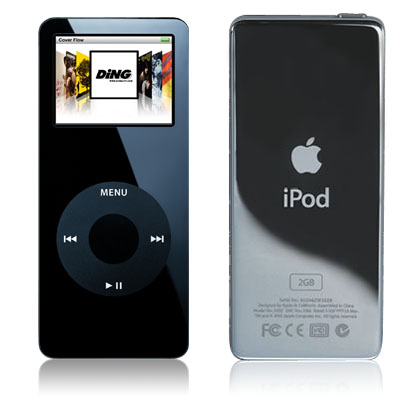
Apple reported that the battery in the first-generation iPod nano may overheat and pose a safety risk. Although, Apple had previously said that less than 0.001 percent of first-generation iPod nanos experienced the overheating issue, Apple has recently initiated a replacement program for the first-generation iPod nano. The company recommended users of the first-generation iPod nano to stop using the device and replace it for free.
The defect was firstly traced in 2008, when several customers experienced overheating on their first-generation iPod nano. South Korea, Japan and Europe international government agencies even initiated a special investigation and as a result the trade ministry in Japan ordered Apple to publicize the replacement offer on its Japanese website in 2010. Now Apple is notifying purchasers of the first-generation iPod nano about the replacement program, sending out emails.
"Apple has determined that, in very rare cases, the battery in the iPod nano (1st generation) may overheat and pose a safety risk. Affected iPod nanos were sold between September 2005 and December 2006," the company wrote. "This issue has been traced to a single battery supplier that produced batteries with a manufacturing defect. While the possibility of an incident is rare, the likelihood increases as the battery ages."
Apple Jumps to Fourth in Greenpeace's Environmental Rankings of Electronics Companies
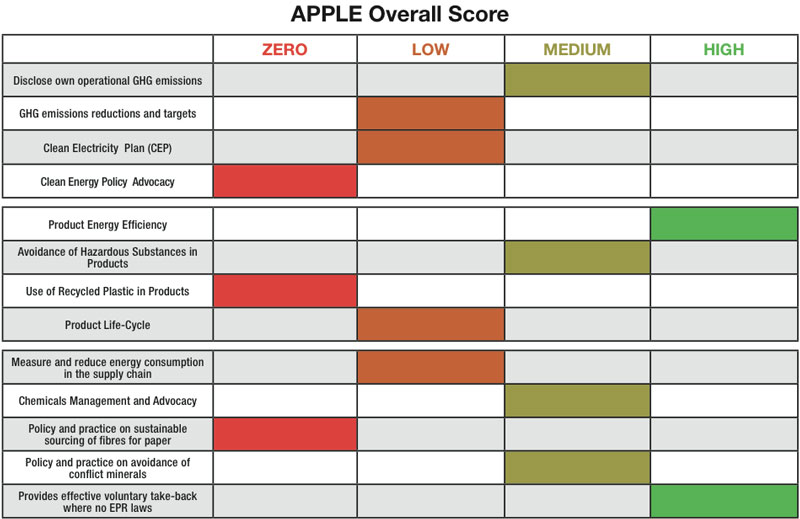
Greenpeace ranked 15 companies across three areas: energy, greener products and sustainable operations and released its "Guide to Greener Electronics" on Wednesday. This time Apple took fourth place in the rating up five places from the previous report. Nokia (4.9/10), Dell (5.1/10), and HP (5.9/10) were on the third, second and first places respectively. Immediately below Apple were Philips (4.5/10), Sony Ericsson (4.2/10), Samsung (4.1/10) and Lenovo (3.8/10).
The organization criticized Apple for the fact that Apple has not specified any target to reduce emissions. Nevertheless, Greenpeace gave the company credit for use of renewable energy and improved energy efficiency. Apple is also very demanding for product criteria. So all of the company's devices are free of PVC vinyl plastic and brominated flame retardants.
But Apple’s relationships with Greenpeace are not limited by positive experience only. "For years now Apple has pushed the environmentally friendly aspects of its products, countering a dispute that began with Greenpeace in August of 2006, when the organization issued a report condemning Apple for the use of toxic chemicals in its devices. Greenpeace also pulled a number of publicity stunts, such as a "Green My Apple" campaign in London in October of 2006, and a "greening" of Apple's flagship Fifth Avenue glass cube in January of 2007."