 iPhoneRoot.com

News from category ‘Official’
Apple selling record 30 million iPhones in December quarter
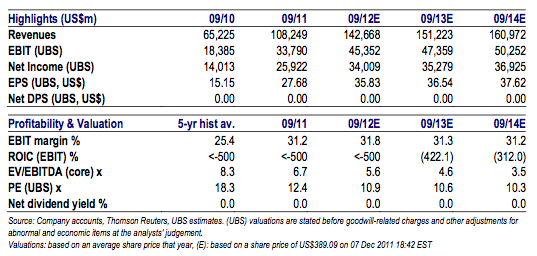
UBS (Investment Firm) analyst Maynard Um now believes Apple will sell as many as 30 million iPhones in the December quarter, up from a previous estimate of 28 million. The firm changed its expectations for the iPhone sales because of AT&T's announcement that it expects its best smartphone quarter ever thanks to the iPhone 4S.
The firm didn’t change its predictions for the iPad. It still expects that Apple will sell 12 million units in the fourth quarter of 2012 and may achieve 13 million iPads because of seasonal boost during the holidays. UBS numbers are quite conservative due to its belief that "there might be a slight shift in consumer preference to the company's Macbook computers." Um said customers may not be able to buy multiple Apple products simultaneously and could instead elect to purchase larger ticket items with more functionality.
In light of the expected iPhone upside, UBS raised its revenue estimates to $38.5 billion, up from $37.2 billion. The firm now expects earnings per share to reach $9.90, compared to a previous projection of $9.47. For fiscal 2012, Um sees Apple bringing in $142.7 billion in revenue and $35.83 EPS.
 Leave a comment
Apple Submits Revised Plans and Renderings for Apple's New Campus

Apple has reportedly submitted revised plans for their so-called "Spaceship" campus. The company plans to break ground on the project next year and open the facility in 2015. This mega-campus in Cupertino, Calif., is expected to provide Apple with approximately 2.8 million square feet for up to 13,000 employees. Late Apple co-founder Steve Jobs personally presented the original plans for the campus to the City of Cupertino in June. Following Jobs' presentation, city officials quickly voiced support for the project. Jobs described it as follows:
It's a pretty amazing building. It's a little like a spaceship landed. It's got this gorgeous courtyard in the middle... It's a circle. It's curved all the way around. If you build things, this is not the cheapest way to build something. There is not a straight piece of glass in this building. It's all curved. We've used our experience making retail buildings all over the world now, and we know how to make the biggest pieces of glass in the world for architectural use. And, we want to make the glass specifically for this building here. We can make it curve all the way around the building... It's pretty cool.
The City of Cupertino posted an update to the company's "Apple Campus 2 Project" on Tuesday evening. Though most of the new renderings are higher-quality versions of the original design, some of the images show a darker color for the structure's roof. Other changes include addition of parking plans, drawings for a private jogging path and a proposed expansion of the corporate fitness center from the original proposal of 25,000 square feet to 45,000 square feet.
Apple Admits to Court that Samsung Will Draw More Customers from Android than iOS
Early today, we have reported that the U.S. judge declined to issue a preliminary injunction barring Samsung from selling several of its Galaxy smartphone and tablet devices in the United States. We have also mentioned the court order that had been redacted and which revealed that Apple had licensed one specific iOS interface patent to both Nokia and IBM. Now Reuters reports how this court order came to light.
In her 65-page ruling denying Apple's request for a preliminary injunction against Samsung, Koh attempted to redact nearly two dozen sentences or short fragments. But because of a formatting characteristic in the prior electronic version, the redacted material can be viewed by copying text from the PDF and pasting it into another document.
In the court order Koh cites as part of her rationale Apple's admission that Samsung is more likely to take market share from other Android manufacturers than it is from Apple.
Apple Fails to Win U.S. Injunction Against Samsung
Late last week, a U.S. judge Lucy Koh declined to award a preliminary injunction over Galaxy line of smartphones and tablets in the United States. The Judge admitted that Samsung infringed some of Apple's patents, but she declined to issue a ban, because of a lack of evidences.
In her ruling, Koh wrote that for some of the smartphones, "Apple has established a likelihood of success on the merits at trial."
Koh added that Apple would likely prove Samsung infringed one of its tablet patents. However, Apple had not shown that it was likely to overcome Samsung's challenges to the patent's validity, Koh wrote.
Apple must demonstrate both infringement and validity to succeed in its lawsuit.
Interestingly, Apple has licensed to third parties one key iOS patent covering the "scrollback" feature displaying the linen texture when elastically scrolling beyond the end of a document or webpage. Licenses for the patent were obtained by Nokia and IBM, and Apple offered a license to Samsung.
Apple asserted this patent against Samsung as part of its failed attempt to get an injunction against Galaxy devices, and the court order denying the injunction includes general discussion of how past licensing behavior affects the decision of whether or not to grant an injunction. The discussion is nestled among two redacted statements shown to The Verge that confirm the '381 patent was licensed to IBM and Nokia, and that Apple offered a license to Samsung in November of 2010 as part of settlement negotiations.
The fact that Apple has been willing to gain profit from a license offered to other companies undermines its argument that it is being irreparably harmed by Samsung's alleged infringement.
Apple offered alternative designs for Galaxy Tab

Comparison of iPad and Galaxy Tab profiles
The Verge reports that Apple offered an alterative design for Samsung’s Galaxy Tab 10.1 in its July court case seeking a sales ban of the Galaxy Tab 10.1. Apple gave Samsung a list of tweaks that would allow the company to differentiate the two tablets (iPad and Galaxy Tab) and start selling Samsung’s Galaxy Tab not violating Apple’s patents.
The Korean electronics company argued that the patents Apple is using against the Galaxy Tab were based on functionality, and are thus required by all smartphones and tablet computers as part of a basic utilitarian design that is why Samsung had to use the design elements in question. But Apple believes that Samsung could use other options and that the Korean company purposely violated standing patents. To prove its point, Apple generated a list of possible alternatives that included:
- A front surface that is not black.
- A shape that is not rectangular.
- No rounded corners.
- A front surface that is not flat.
- Varying Bezel size.
- A device that is not thin.
- A cluttered appearance.
In response, Samsung slightly changes design of its tablet and rebranded it the Galaxy Tab 10.1. However, Apple did not find these changes sufficient to warrant the lifting of the injunction.
Apple Wins One-Week Extension of Galaxy Tab Sales Ban in Australia
Just a day after Australian appeals court lifted the sales ban on Samsung's Galaxy Tab 10.1, Apple has managed to win a one-week extension of the ban yesterday, according to Bloomberg.
High Court Justice John Dyson Heydon today extended the ban on the release of Samsung’s Galaxy Tab 10.1 to Dec. 9. On that day, the country’s top court will consider Apple’s request for permission to appeal a lower court’s order issued earlier this week, which lifted a ban on the product that has been in place since mid-October.
“A stay for one week will cost Samsung, in effect, one week’s trade,” Heydon said, following a 90-minute hearing in Sydney. The extension will hurt Samsung “but not to extend the status quo is likely to be injurious to Apple,” he said.
Samsung has been reportedly planning to begin selling the Galaxy Tab 10.1 in Australia today. The company was rushing to bring the device to the market it time for the holiday shopping season, but has had to postpone its plans.
Samsung argued that every day of delay is crucial as the clock continues ticking on the holiday shopping season, claiming that Apple has no basis for an appeal of the ruling, but the court is willing to keep sales on hold until it can hear Apple's side of the request for appeal.
96% of Customers Satisfied with iPhone 4S
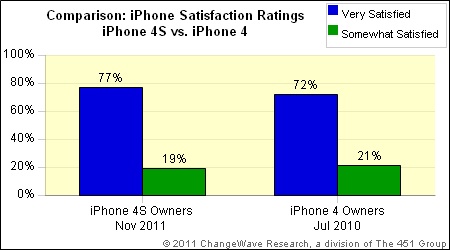
Research firm ChangeWave released on Thursday results of an early November survey of iPhone 4S owners that shows that 77 percent of respondents indicated they are "very satisfied" with their iPhone 4S, another 19 percent said they are "somewhat satisfied," while j 2 percent fell into the "unsatisfied" category. After launch of the iPhone 4, 72 percent of Apple customers were "very satisfied" with their purchase, and 21 percent were "somewhat satisfied."
ChangeWave also asked customers what their favorite specific features of the iPhone 4S are. Siri topped the list of most-liked features on the iPhone 4S, with nearly half of survey respondents citing it. Second place was ease of use with 39 percent, and the new 8-megapixel camera took third with 33 percent. Faster Web browsing was the fourth most popular feature at 24 percent, the high-resolution Retina Display took fifth with 23 percent, and iCloud service was in sixth with 19 percent.
Apple stores to participate in World AIDS Day by promoting (RED) products
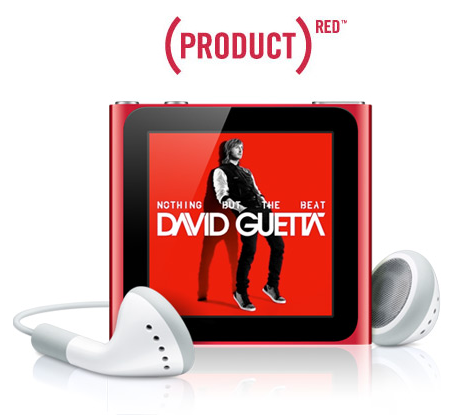
Apple retail stores are taking part in World AIDS Day today, on December 1. The company is drawing attention to its (RED) products, which raise money to fight AIDS in Africa. ifoAppleStore reports that a "select group of Specialists will be wearing and promoting the (RED) iPod nano" to mark the day set for international AIDS awareness.
Apple sells 8GB and 16GB (RED) iPod nano models for the same price as other models, but a part of money that Apple will receive this day, will be donated to the Global Fund in order to fight AIDS in Africa. The company also offers a (RED) leather iPad Smart Cover, Special Edition (RED) Beats by Dr. Dre Solo HD Headphones, as well as a (RED) iTunes gift card. Managers also have to use the (RED) Smart Covers for iPads during this day.
The idea of this (RED) project belongs to U2 lead singer Bono and Bobby Shriver. Apple has been the largest contributor to the Global Fund to Fight AIDS.
"This is serious and significant," Bono wrote. "And Apple's involvement has encouraged other companies to step up."
Apple still No. 1 manufacturer in growing US smartphone market
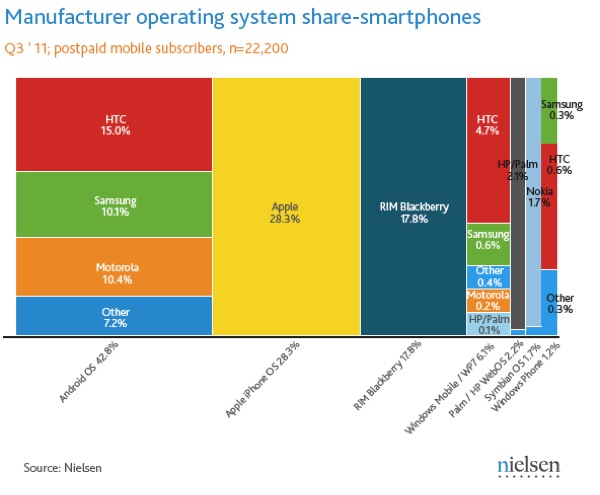
According to findings released on Tuesday by Nielsen, Apple remained the largest smartphone manufacture in the Unites States in the third quarter. While smartphones sales continue to grow in the U.S., accounting for 56 percent of all cellphone sales in the prior quarter, Apple’s market share has reached 30%. Apple's third quarter performance was followed by HTC with a 20.3% share.
As for mobile platforms, Android and iOS dominate with a 71.1% share, holding 42.8% and 28.3% respectively. About a half of all mobile users in the United States owns a smartphone. During the prior quarter 56% of all handsets purchases were smartphones. The third place still belongs to RIM's BlackBerry platform with 17.8% that was followed by Microsoft's Windows Mobile platform, HP's Palm/webOS, Symbian and the fledgling Windows Phone.
App downloads in the third quarter saw that Google and Apple have the largest share. 83% of all downloads were made through Android and iOS devices. But Google has recently expressed dissatisfaction by the situation with app downloads, and hinted at upcoming changes that would bring its online store more in line with Apple's.
Samsung Galaxy Tablet Ban in Australia Lifted, Apple to Appeal

Sydney Morning Herald reports that an Australian court has overturned a preliminary injunction against Samsung's Galaxy Tab 10.1. Apple was able to extend the ban until Friday at 4pm while it prepares for an appeal to the High Court.
The full bench of the Federal Court - Justices John Dowsett, Lindsay Foster and David Yates - today unanimously reversed a Federal Court judge's ruling last month that Samsung's Galaxy Tab 10.1 be banned from sale in Australia.
"Samsung will be permitted to launch the Galaxy Tab 10.1 in Australia provided it keeps accounts of all transactions involving that device in Australia," the judges wrote in their judgment.
The original ruling came last month from Justice Annabelle Bennett. Following the initial injunction, Samsung was quick to appeal the decision in hopes of releasing the device in time for the valuable Christmas shopping season. Samsung lawyer Neil Young said in October that the Galaxy Tab 10.1 would be "dead" if it was delayed past Christmas.
Apple Seeks Ban on Sales of Revised Samsung Galaxy Tab 10.1N in Germany
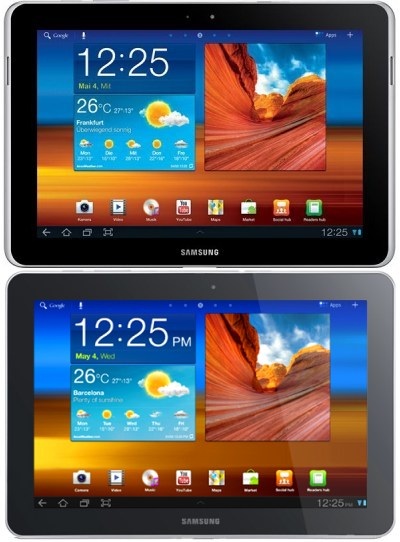
Galaxy Tab 10.1N (top) vs. Galaxy Tab 10.1 (bottom)
Apple has reportedly filed a request for a preliminary injunction to prevent sales of the revised Galaxy Tab 10.1N, a design-tweaked variant of the original Galaxy Tab 10.1, in Germany. Samsung launched Galaxy Tab 10.1N last month in attempt to deal with the ban on Galaxy tab 10.1 sales in the country.
Apple has requested a preliminary injunction, and the Duesseldorf regional court has scheduled a hearing on the matter on Dec. 22, a spokesman for the court told Dow Jones Newswires on Tuesday.
The move has no effect on sales and distribution of the product, Samsung said in an emailed statement, while Apple repeated earlier comments that it intends to protect its intellectual property.
Apple clearly believes that slight changes in design of the Galaxy Tab 10.1 are not sufficient to overcome the ruling that the Galaxy Tab design is almost similar to the design of the Apple’s iPad, and that is why Apple has decided to claim a new injunction.
Samsung attorney says Australian judge wrong in banning its iPad-like tablet
Samsung's attorney Neil Young claims that Australian judge Annabelle Bennett was wrong in granting Apple a temporary injunction against the Galaxy Tab. He stated at an appeal hearing that she made a series of errors and did not understand key elements of the case. The judge issued the ban on the basis of just two of the patents, but Apple’s claims are based on 13 company’s patent infringements. So the judge decided that they were enough to warrant a temporary sales ban until the full case will be solved. However, Samsung may lose their customers during the holiday sales season at least in Australia.
As far as we know, Apple is also suing Samsung in California and in some other countries. A separate injunction on sales was won by Apple in Germany. Rather curious incident occurred in the US court. A judge, who held Samsung’s Galaxy Tab and Apple's iPad in the air, asked Samsung's attorneys to identify which one is made by Samsung. Surprisingly, the attorney preferred to evade a question.
Of course, Apple's attorney Stephen Burley does not agree with Samsung's attorney. He believes that Bennett reviewed the infringement case in a detailed fashion. Moreover, he claims that Apple had good chances to win infringement.
Analysts See iPhone 4S Supply Constraints Throughout Holiday Quarter

Fortune has analyzed two reports and suggests now that Apple may be experiencing some supply constrains on the iPhone 4S throughout this holiday quarter. The company, no doubt, works hard to stock-pile necessary number of the iPhone 4S that will allow Apple to meet customer demand for its newest smartphone, as well as shipping estimates of iPhone carrier partners during this quarter, but Apple may be having some trouble meeting its own production goals for the device that will result in supply constrains.
The first report, from Rodman and Renshaw analyst Ashok Kumar, alerted the company’s clients about the iPhone 4S production constrains, citing that shortages of an unidentified "key component" for the iPhone 4S that is holding back production. Kumar says that Apple has four million iPhone 4S not sold in the prior quarter. Taking into account there numbers, he suggests that Apple may sell 30 million iPhones during this quarter, though the company won’t be able to completely satisfy consumer demand.
The second note comes from Susquehanna Financial's Jeff Fidacaro. He also says that the main problem for Apple in this quarter is "supply constraints". As a result, we see reduction in quarterly iPhone sales of about three million units, moving from 26-28 million units to 23-25 million units.
Smoking, glowing iPhone 4 causes airplane scare

Regional Express (REX), Australian largest independent regional airline, had to extinguish a glowing iPhone 4, emitting “dense smoke” while a flight from Lismore to Sydney. A flight attendant extinguished the smoking smartphone and no one was injured during the incident. The situation, obviously, has sparked concerns over the handset's battery. The defected device was the GSM version of the iPhone 4, according to the model number of the device.
This issue, probably, caused by battery overheating wasn’t a unique one for Apple's devices. As far as we know, the company recently initiated a replacement program for the first-generation iPod nano due to potential battery overheating issues earlier this month, although Apple notes that the problem is very rare, but the likelihood of overheating does increase over time.
One of the biggest consumer electronic battery scares in recent years occurred in 2006. Microscopic metal particles were found in 9.6 million lithium-ion Sony batteries that the company had to recall. Such batteries were also used in Apple’s iBook and PowerBook G4 and Apple recalled 1.8 million batteries.
Pent-up demand helps iPhone take top spot in UK market with 43% share
According to research firm Kantar Worldpanel ComTech, demand for Apple’s iPhone 4S helped the company to push it market share in the UK to nearly 43% in October. Apple's U.K. market share increased 2.8 percent to 27.8 percent year-to-year and it is the first time since late 2010 when Apple’s sales beat Android-based handset sales in the region.
"Apple took a whopping 42.8 percent share of all smartphone sales, giving it a significant lead over Android - a feat many thought was impossible," said Dominic Sunnebo, global consumer insight director at the firm.
About 75 percent of British customers who purchased an iPhone 4S in October already own a previous version of the device, with 14 percent upgrading from last year's iPhone 4. Sunnebo claims that the main driver for the sales of the iPhone 4S in the U.K. was the existing iPhone users. The second driver is rather long period between the launches of the iPhone 4 and 4S.