 iPhoneRoot.com

News from category ‘Hardware’
Apple to launch iPhone 4S in China and 21 more countries January 13

Apple finally announced the forthcoming debut of the iPhone 4S in China in a press release on Wednesday. The iPhone 4S is set to launch in China and 21 additional countries across the world on Friday, Jan. 13.
"Customer response to our products in China has been off the charts," Apple Chief Executive Tim Cook said in a statement. "With the launch in China next week, iPhone 4S will be available in over 90 countries making this our fastest iPhone roll-out ever."
In addition to China, Jan. 13 will also mark the launch of the iPhone 4S in Anguilla, Antigua and Barbuda, Bolivia, Botswana, British Virgin Islands, Cameroon, Cayman Islands, Central African Republic, Dominica, Dominican Republic, Ecuador, Grenada, Guam, Guinea Conakry, Ivory Coast, Jamaica, Kenya, Madagascar, Mali, Mauritius, Niger, Senegal, St. Vincent and The Grenadines, Trinidad and Tobago, Turks and Caicos and Uganda.
Rumors have suggested that Siri, Apple's voice-controlled personal assistant service on the iPhone 4S, will gain support for Mandarin, the most popular form of the Chinese language, by March of 2012. Noteworthy, some regional branches of China Unicom in mainland China had already gained profit from iPhone 4S launch having offered bookings for the handset in anticipation of the device's launch.
Apple reportedly planning New York City media event this month

All Things D reported on Monday that Apple is reportedly planning an event scheduled to take place in New York at the end of January. The company is said to use the event as a platform for an advertising or publishing announcement. Of course, many anxiously await the announcement of a much anticipated iPad 3 or new Apple TV, which some think will be launched later in 2012. Apple usually reserves product launches and important announcements for its home-state like the latest iPhone 4S, which debuted on Oct. 4, 2011 at Apple's campus.
According to sources close to the situation, Apple is planning an important — but not large-scale — event to be held in New York at the end of this month that will focus on a media-related announcement.
Per the usual caveat, the tech giant is well known for moving around their public show-and-tells, so this could certainly change at any moment.
Several of Apple's media and advertising units have significant presences in New York City, and Apple Senior Vice President of Internet Software and Services Eddy Cue (Cue is currently heading up the iTunes Store, App Store, iBookstore) is said to take part in the end of the event that has caused rumors suggesting that Apple’s announcement may be connected with advertising or publishing.
Apple again rumored to switch to IGZO displays for 'iPad 3'
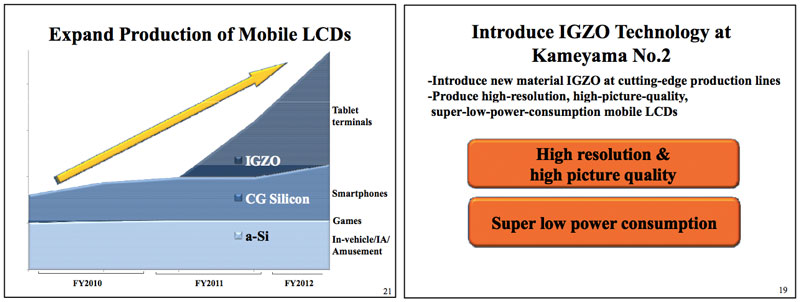
Digitimes has reported that Apple will be utilizing IGZO (indium gallium zinc oxide) flat panels instead of IPS (in-plane switching panels) in its "next-generation mobile display products" such as the iPad 3.
Starting with the new iPads, Apple will utilize IGZO panels from Sharp in order to upgrade the display resolution of the new tablets to full HD level, the sources indicated.
Though, such rumors aren’t new ones. We have already heard that Apple could use this technology in the next-generation iPad. A research note from Jefferies analyst Peter Misek back in November made very similar claims:
Also, we believe that Apple and Sharp together have a modified IGZO (indium, gallium, zinc) technology to achieve 330 dpi, which is sufficient for an HD display while not using IPS nor having to include dual-bar LED backlighting. In our view, this should lead to several design advantages, namely the device can be thinner, battery life should be longer, and the overall experience for users should be meaningfully improved.
In April, Sharp revealed its plans to commercialize new IGZO panels for mass production later this year. DisplayBlog recaps the advantages of this new technology:
The benefits of IGZO are plenty: lower cost of manufacturing, up to 30x higher electron mobility than a-Si (amorphous silicon), increased aperture ratio for improved light transmittance, higher resolution in terms of ppi, etc. IGZO would allow for significant cost reductions compared to LTPS (Low Temperature Poly-Silicon).
The new technology is said to allow Apple not to use a second light bar system that is presently used in the iPad and to avoid making the iPad 3 thicker than the current iPad.
Unverified photo may show pre-production iPad 3 Retina Display
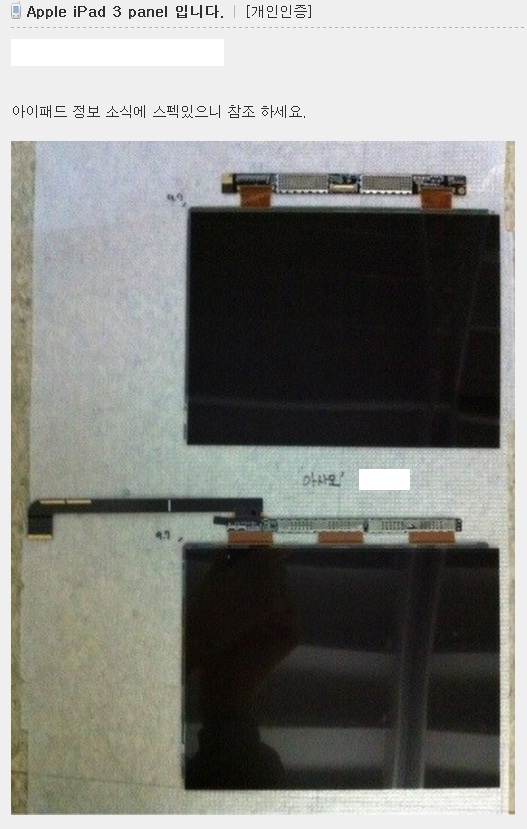
A Korean forum (via MacRumors) published on Friday an unverified photo of the much rumored iPad 3's high-resolution display, and reveals a subtle change from the iPad 2 that could suggest a higher resolution panel is being sourced for the upcoming tablet. An image shows a component that has three ribbon cable connectors instead of the two found on current iterations of the device.
Little to no information accompanied the photo. It is only believed that the image is a comparison shot of a current iPad 2 panel sitting above an alleged iPad 3 display.
As you can see there are 3 brown ribbon cables leading from the screen itself to the circuit board. The small brown cable to the far left is the power cable, while the other two wide cables are for display data. This configuration matches with the top display in the leaked photo (though the power cable is missing).
The claimed iPad 3 photo shows 3 wide ribbon cables that might be used for data. The iPad 3 is expected to carry a high resolution screen of 2048x1536 which is four times the number of pixels of the current iPad 2, so the need for additional data bandwidth would be understandable.
Apple reducing iPad 2 orders
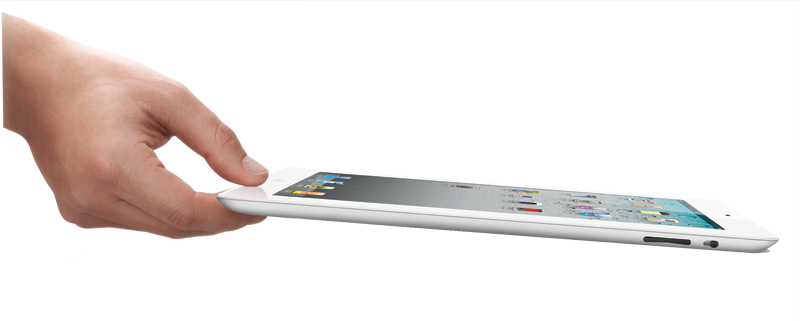
Sources in Apple's supply chain told DigiTimes that Apple has begun reducing orders for the iPad 2 ahead of the unveiling of an anticipated third-generation iPad. While iPad 2 orders are being reduced, orders for the next iPad, reportedly set to launch in March of 2012, remain steady. It's not yet known whether Apple will keep the iPad 2 around at a discounted price. There are some rumors claiming that Apple would remain it available at a discounted price in order to take on Amazon's $199 Kindle Fire. It is known that Apple has gained great success in continuing to sell older iPhone models at discounted prices. The iPhone 3GS is still remaining the number 2 smartphone in the United States.
Various reports have suggested that Apple will continue to sell the iPad 2 at a discounted price after it launches a third-generation iPad. Apple already employs that strategy in offering the iPhone 3GS, first released in 2009, as an entry-level handset, in addition to the iPhone 4, released in 2010, and iPhone 4S, which just launched in October.
There are also lots of rumors suggesting that in 2012 Apple plans to introduce new models of the iPad with different features at a number of price points. Many analysts believe that Apple indeed will launch the next-generation iPad with a high-resolution Retina Display.
Apple could collect $10 for every Android device sold

Kevin Rivette, managing partner at intellectual property firm 3LP Advisors LLC, said in an interview with Bloomberg that if Apple were to abandon its lawsuits against Android smartphone manufacturers and instead negotiate licensing fees for its patented technology, Apple could collect $10 for each Android device sold. But as far as we know Apple is not interested in licensing Apple's patented technology to Android manufacturers. Steve Jobs called the Android products as the “stolen” ones and wanted “to go thermonuclear war” against Android.
"A scorched-earth strategy is bad news because it doesn't optimize the value of their patents -- because people will get around them," Rivette told Bloomberg.
"It's like a dam. Using their patents to keep rivals out is like putting rocks in a stream. The stream is going to find a way around. Wouldn't it be better to direct where the water goes?"
Such approach makes mobile devices manufacturers to modify their infringing products and work around Apple's intellectual property. For example, earlier this month, the U.S. International Trade Commission found that HTC was in violation of an Apple patent related to "Data Detectors," but only a day later HTC said it was testing new devices that work around Apple's patent.
Foxconn Likely to Win Contract for Building Apple Television Set

Digitimes now claims that it has obtained new portion of information on the rumored Apple’s television. The main role in manufacturing and assembling of the new TVs is expected to be played by Foxconn, Apple's primary iOS device manufacturing partner. The company is likely to win the contract for assembly of the television set products.
Following sources' claims that Samsung Electronics and Sharp will manufacture chips and displays, respectively, for the so-called Apple "iTV," others have suggested that Taiwan Semiconductor Manufacturing Company (TSMC), Advanced Semiconductor Engineering (ASE) and Siliconware Precision Industries (SPIL) have the potential to win orders for Apple's smart TV.
Foxconn Electronics (Hon Hai Precision Industry) likely will obtain assembly orders for the Apple smart TV, according to industry sources.
We have already reported that Apple is going to finalize Apple’s TV design by the end of the second quarter and launch the television sets by the end of the year. Moreover, the analyst Shaw Wu at Sterne Agee has suggested that Apple may be interested in disrupting the television industry on the content side by launching its own television services which, obviously, will be connected with Siri.
"This is obviously much more complicated (than current offerings) from a licensing standpoint," Wu wrote in a note to investors on Wednesday. "And in our view, would change the game for television and give AAPL a big leg-up against the competition."
Hardware and technology are not the issues holding back Apple from releasing a television set, he said. Instead, Apple must negotiate unique content deals that will allow the company to differentiate its product from other televisions on the market.
Apple television said to run on customized chips like iPhone, iPad
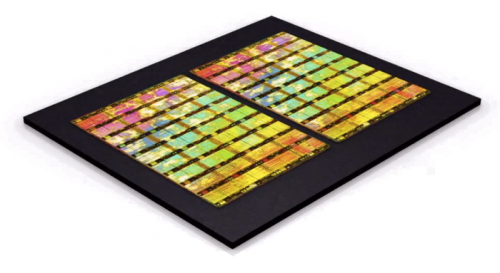
Apple is expected to build its own chips like in the iPhone and iPad for its anticipated television set, instead of utilizing third parties chips from a company such as Intel.
Taiwan Semiconductor Manufacturing Company (TSMC), Advanced Semiconductor Engineering and Siliconware Precision Industries are three companies expected by DigiTimes to bid on orders with Apple. The companies could build custom ARM-based chips to power an Apple television, much like the A4 CPU, first released in the iPad in 2010, is found in the current Apple TV set-top box.
Earlier this year we reported that Apple signed the agreement on the production of next-generation "A6" and "A7" processors for the iPhone and iPad with TSMC and would utilize its 28nm and 20nm process technologies. It is possible that Apple television set will use the same iPhone and iPad’s chips. The Apple TV is also expected to be assembled by Foxconn Electronics, which is the manufacture of most of Apple’s devices.
Apple will have finalized the hardware standards for its television set by the end of the second quarter of 2012, only after that, the company will begin placing orders for its customized chips. Apple already used such approach to build its iPad and iPhone lineups.
Apple granted another key multitouch patent
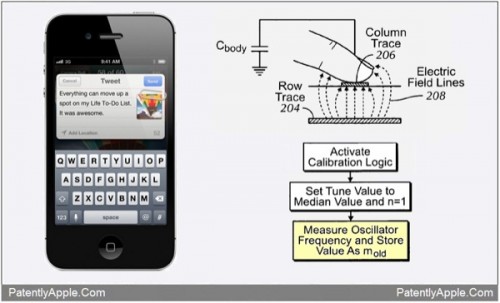
The United States Patent and Trademark Office published on Tuesday that Apple won a core multitouch patent that describes how touch events are recognized by a touchscreen device. The patent blog Patently Apple also noted that this patent was one of the "200+ Patents for new inventions" Jobs lauded when the iPhone first debuted in 2007.
The newly granted patent focuses on the oscillator signal and circuit of a touchscreen-equipped device, an integral invention directly related to how users interact with their multitouch products.
Apple states in the filing: "In general, multi-touch panels may be able to detect multiple touches (touch events or contact points) that occur at or about the same time, and identify and track their locations."
One way to record multiple touches is to generate an oscillating signal circuit that can power and clock inputs over a substrate as in a capacitive touchscreen display. But it is difficult to create a precise circuit-based oscillator. According to Apple's patent, the solution to capacitive touchscreen problem is to calibration logic circuitry which compares the signal oscillation against a reference signal and tunes the clock frequency accordingly. The invention provides for an accurate capacitive display that can not only sense multiple touches, but also detect hover or near touches which are also recognized as "touch events."
iOS, Android activations surge 353% on record setting Christmas Day
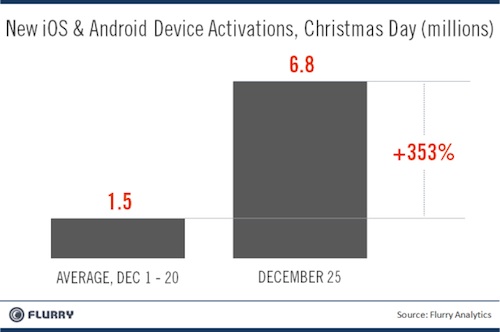
In the first 20 days of December, mobile device activations tracked by analytics firm Flurry were around 1.5 million each day. As for December 25, it indicated that devices running Apple's iOS and Google's Android platforms saw a huge spike in activations, growing 353 percent from average totals earlier in December. The previous record tracked by Flurry belongs to Christmas Day in 2010. On December 25, 2010 the users activated 2.8 million devices.
Flurry's statistics come from the company's analytics software, which is found in more than 140,000 applications. Peter Farago, vice president of marketing with Flurry, claimed that his company's statistics detect "roughly" 100 percent of new iOS and Android devices activated each day. Application downloads on both iOS and Android also grew by 125 percent on Christmas Day, reaching 242 million. For the first 20 days of December, downloads averaged 108 million.
Flurry expects that by the end of the year 2011 Apple's App Store will exceed 10 billion application downloads. Moreover, iOS applications rake in 300 percent more revenue than their Android counterparts. During Apple’s last quarterly earnings conference call Apple has not revealed daily iOS activations in over a year, but announced that more than 250 million iOS devices had been sold during the quarter.
Argentina blocks iPhone sales in bid to strengthen economy

The Argentinean government has temporarily blocked sales of certain electronics including Apple's iPhone and RIM's BlackBerry. Such measures were attempted in order to stabilize the country's ailing economy, to slow rising inflation and correct the disparity between the pesos and U.S. dollar, while suggesting that companies must build plants in the country to resume sales.
In order to continue smartphone sales in Argentina, Apple must build a plant or partner with a local company to manufacture the iPhone. RIM is reportedly looking to partner with an existing plant so that it can continue sales in the region. Other handset makers like Motorola, Nokia and Samsung have already moved or built plants in Argentina's Tierra del Fuego free zone after the government passed the Internal Revenue Law of 2009, which added a 20.48 percent tax to the existing 21 percent VAT for certain imported electronic devices.
According to Argentinean site Fortunaweb, iPhone and BlackBerry sales comprised 60 percent of the total market in October. And to strengthen the Argentinean economy, the government made decision to support local manufactures, banning some electronics manufactures from sales in this country. The Economist reported in December article that "a slowing year-to-year GDP blamed on decreased demand for agricultural commodities and huge government subsidies have caused the country to enact tighter controls on capital flight".
Apple to launch iPhone 4S in mainland China before Jan. 23

China's People's Daily reported this week that Apple had met all of the requirements for the iPhone 4S to launch in mainland China, and Ministry of Industry and Information Technology granted China Compulsory Certification for the iPhone 4S on December 22. The report claims that the handset will be launched in mainland China before the Chinese New Year that takes place on Monday, January 23, 2012.
Filings with the Chinese government show a WCDMA phone manufactured by Apple was granted approval. Though it does not specifically reveal that the device is the iPhone 4S, it is listed as model number A1431, which is the same number Apple used to obtain a network entry permit for the iPhone 4S. The approval process and anticipated release of the iPhone 4S has dragged out in China as Apple has quickly launched its latest smartphone in other major markets around the world. It's been the fastest rollout ever for a new iPhone model.
Some regional branches of China Unicom have already started taking preorders for the iPhone 4S in anticipation of the device’s launch. Moreover, Siri, Apple's voice-controlled personal assistant application, is rumored to gain support for Mandarin by March of 2012 that will obviously drive sales of the iPhone 4S in China.
Apple Planning Completely Redesigned iPhone for Fall 2012 Launch
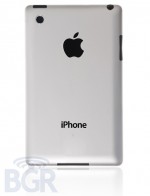
BGR claims that Apple is planning to launch a completely redesigned iPhone in the fall of next year. The new iPhone will haven an aluminum back panel rather than the glass one with the incorporation of a rubber or plastic bezel covering similar to that used on Apple's iPhone bumpers. The device’s antennas will be also covered with some protective bezel to avoid direct skin contact.
We have also learned that Apple is planning to use a rubber or plastic material — similar to the material used in the company’s bumper cases — that will be built into the new iPhone case. In all likelihood, this material will be used as a bezel surrounding the front edge of the phone (like the iPhone 3GS bezel) and it will serve two purposes. First, it will join the glass iPhone face with a new aluminum back plate. It will also cover a redesigned antenna system that surrounds the device, allowing Apple to build the rear case out of aluminum without having to use a large plastic insert above the antennas as the company does on its iPad 2 Wi-Fi + 3G.
 Leave a comment, read comments [1]
iPad 3 'Home Button' Parts Start Circulating in China
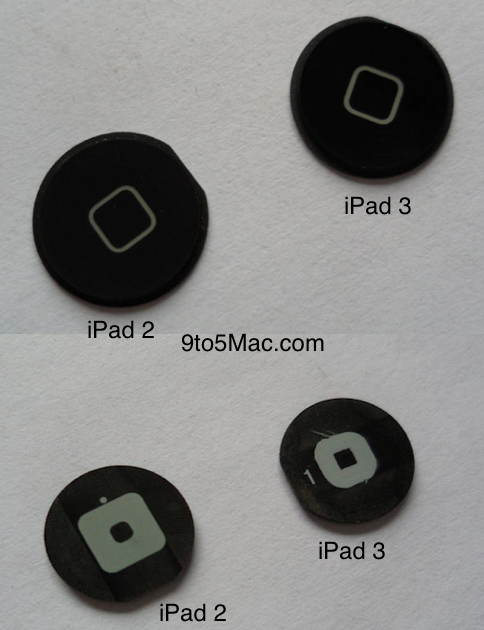
9to5Mac has recently posted photo of the iPad 3 home buttons that was obtained from a Chinese source. Noteworthy, claimed iPad 3 parts have been circulating for some time already in China, but only now photos of the iPad 3’ home button have stated leaking out. No real surprises, though it should help kill already sketchy rumors that Apple might do away with a home button altogether.
The above image is a comparison of an iPad 2 home button and an iPad 3 home button. At the surface, not much as changed, but the prospects of some minor structural tweaks do hint at something greater. The iPad 3 home button, which has been handled in both black and white flavors, looks almost identical to the iPad 2 home button. However, the gray glyph representing the frame of a home screen application icon is slightly thicker.
Perhaps the most interesting part about the iPad 3 home button is that its internal structuring is smaller than the iPad 2′s connector. According to the rumors, Apple had to make home button size smaller to accommodate a more pixel-dense Retina Display.
Basing on this photo, we may suggest the following:
- The iPad 3 will likely to be launched in both black and white colors
- The buttons floating around right now-in large quantities-signal that the iPad 3 is either in production or close to the production stage
- The iPad 3 will have the home button in spite of the rumors claiming that the iOS devices could soon loose the home button
iOS dominates mobile shopping with 92% of market

A study by retail analysis firm RichRelevance released on Friday notes that Apple's iOS dominated mobile online shopping in 2011, holding just over 92 percent of the market, reports Market Watch. iOS users spend 19 percent more than those using Google's platform on mobile purchases.
The study has analyzed 3.4 billion shopping sessions between April and December 2011. The iOS devices share in mobile sales grew from 88 percent in April to over 92 percent in December. This proves that Apple's iOS growth continues to lead the market in many ways including online browsing.
“The numbers across our retailing partners sites demonstrate just how powerful the iOS platform is enabling mobile web shopping and, while still below 5 percent in total conversion, mobile traffic’s doubling in eight months is a trend we only see accelerating,” said Rich Relevance CEO David Selinger.